


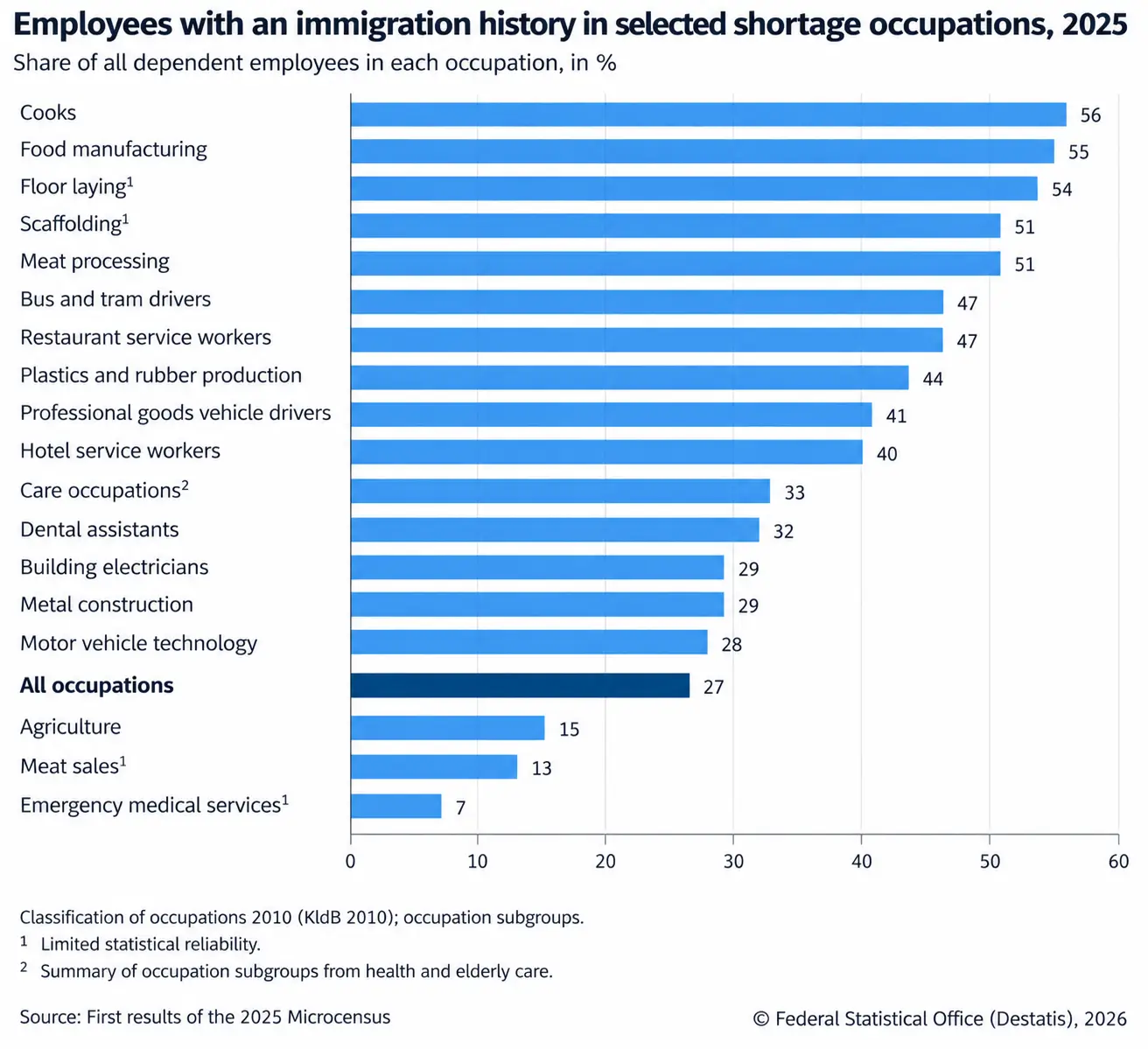
People with an immigration history accounted for 27% of all dependent employees in Germany in 2025, according to the Federal Statistical Office (Destatis). The figure refers to people who themselves or whose two parents immigrated to Germany from 1950 onwards. Their presence was particularly high in many occupations facing or potentially facing skilled-worker shortages, according to the Federal Employment Agency’s shortage analysis.
More than half of all cooks had an immigration history, at 56%. The share was also 55% in food manufacturing, 54% in floor laying, 51% in scaffolding and 51% in meat processing. Bus and tram drivers and restaurant service workers each recorded a share of 47%.
Other shortage occupations also had above-average proportions. These included plastics and rubber production at 44%, professional goods vehicle drivers at 41%, hotel service workers at 40%, care occupations at 33%, dental assistants at 32% and building electricians at 29%. The lowest shares among shortage occupations were recorded in emergency medical services at 7%, meat sales at 13% and agriculture at 15%.
Outside shortage occupations, people with an immigration history accounted for 8% of police officers and 9% each of workers in public administration and judicial administration. The share among teachers was 9% for vocational subjects and 10% for primary education.
Destatis also examined employment among people aged 25 to 59 according to their region of origin and length of residence in Germany. Among people who had lived in Germany for less than five years, 89% of men and 73% of women who had immigrated from EU countries were employed in 2025. The corresponding figures were 79% for men and 47% for women from Africa, and 57% and 28% respectively among people from the Middle East.
Employment rates were higher among people who had lived in Germany for 20 to 25 years. Among African immigrants, employment stood at 82% for men and 68% for women, while among immigrants from the Middle East it was 87% for men and 79% for women. For comparison, among all 25-to-59-year-olds in Germany, regardless of immigration history, 88% of men and 81% of women were employed.
The figures on dependent employees come from the 2025 Microcensus and cover people aged 15 and above living in private households with their main residence in Germany. The employment figures by origin and length of residence cover employed people aged 25 to 59.
From breaking news to thought-provoking opinion pieces, our newsletter keeps you informed & engaged.
By subscribing, you agree to our Terms & Conditions and Privacy Policy.


