


Switzerland has once again emerged as the most sought-after European country for German citizens choosing to live outside their homeland. According to the latest figures released by Germany's Federal Statistical Office (Destatis), approximately 329,900 Germans were registered as residents in Switzerland at the beginning of 2025. This makes them the second-largest foreign nationality group in the country, surpassed only by Italian nationals.
The trend of Germans relocating to Switzerland has been on a steady upward trajectory for several years. Compared to the previous year, the number of German residents grew by 1.9 percent, an increase of roughly 6,300 people. Over the past decade, the German population in Switzerland has expanded by 10.7 percent, translating to approximately 32,000 additional residents.
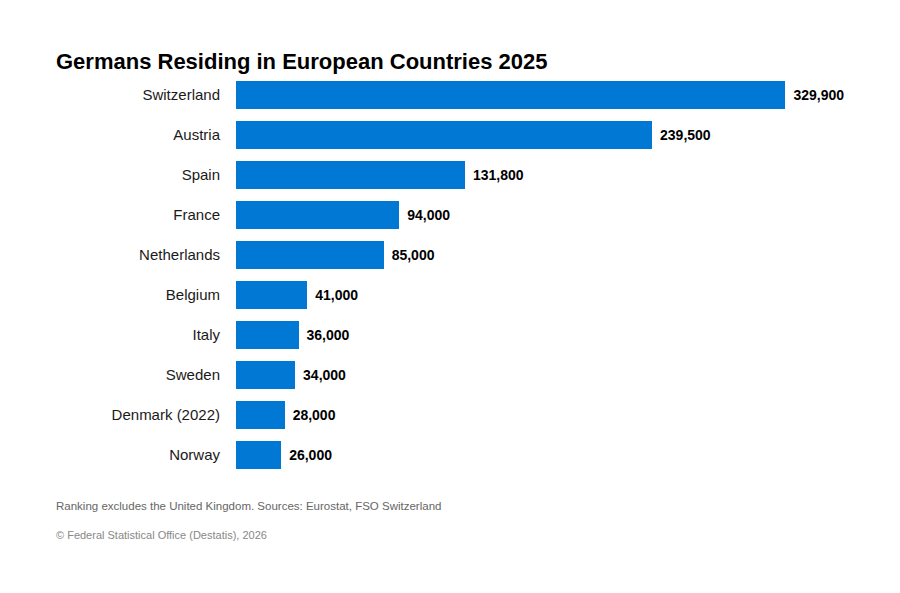
Austria secured the second spot in the ranking, with around 239,500 German citizens calling the Alpine republic home at the start of 2025. Unlike Switzerland, Germans form the single largest group of foreign nationals in Austria. The pace of growth has also been notably faster there, with a year-on-year increase of 2.9 percent, or about 6,700 additional residents.
Over a ten-year period, the German population in Austria surged by an impressive 40.5 percent, equivalent to approximately 69,000 people. Both Switzerland and Austria share borders with Germany and have German as an official language, effectively eliminating language barriers and making the transition considerably smoother for those relocating.
Spain rounded out the top three destinations, with approximately 131,800 German residents recorded in early 2025. After experiencing a prolonged period of declining numbers, Spain has witnessed a renewed uptick in German residents since 2022.
The past year alone saw an increase of 3.0 percent, with around 3,800 more Germans settling in the country. Despite this recent recovery, the total figure remains about 3,000 lower than it was a decade ago, reflecting a 2.4 percent drop over the ten-year span.
While official data on the specific motivations behind these relocations, whether for education, employment, or lifestyle preferences, is not available, the age distribution of German residents across these countries paints a revealing picture. In Austria, the German community skews younger, with only 13.3 percent belonging to the 65-and-older age group.
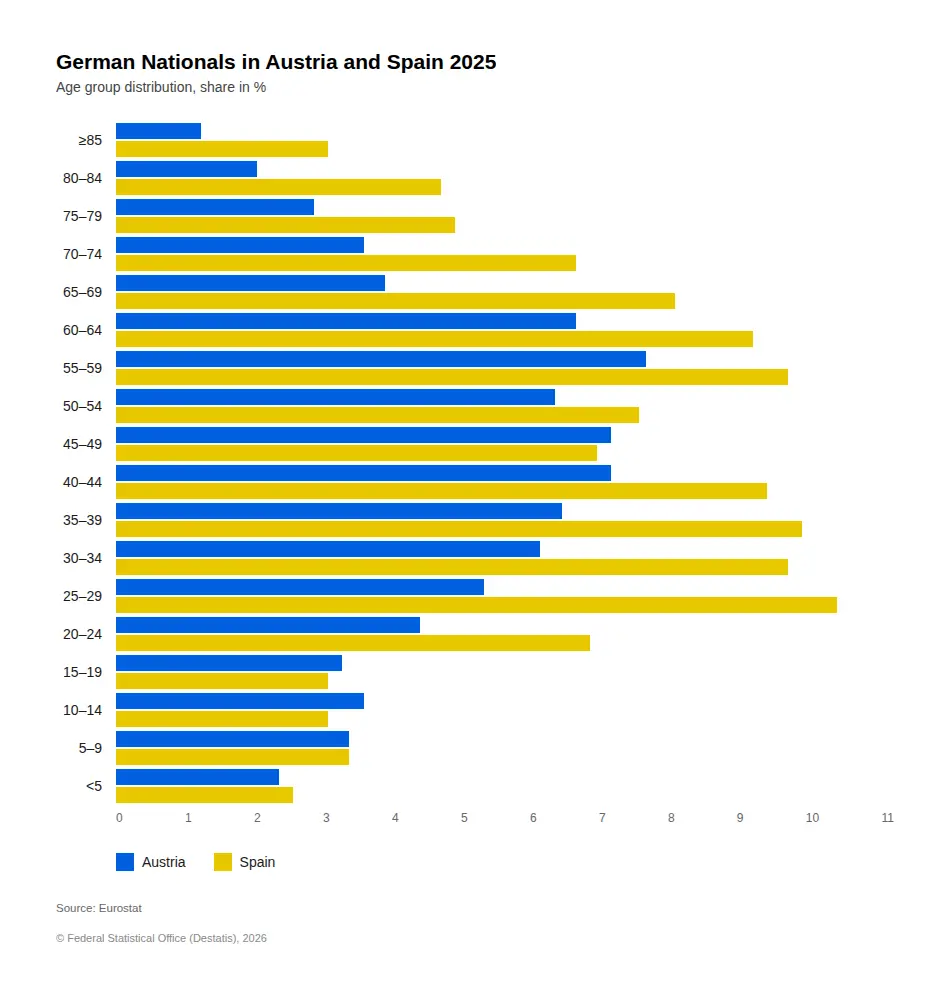
Spain, by contrast, attracts a considerably older demographic, with nearly 26.8 percent of its German residents aged 65 or above, roughly double the proportion seen in Austria. The underlying data was compiled from the EU statistics authority Eurostat and, for Switzerland, from the Swiss Federal Statistical Office. Notably, Germans who also hold citizenship in their country of residence are not counted in these figures.
From breaking news to thought-provoking opinion pieces, our newsletter keeps you informed & engaged.
By subscribing, you agree to our Terms & Conditions and Privacy Policy.


