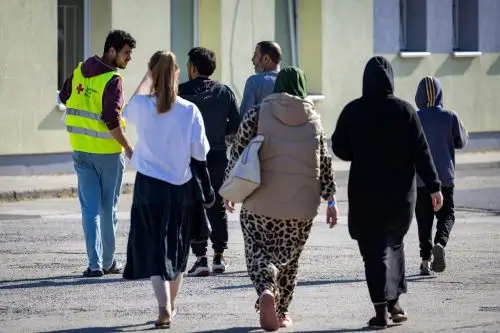
Germany is home to more than four million people who arrived in the country as a result of war, persecution, or displacement, according to figures released by the Federal Statistical Office (Destatis) in Wiesbaden. The data was published on Wednesday to coincide with World Refugee Day on June 20, and draws on preliminary results from the Microcensus.
The figures include not only those who have arrived in recent years but also Germans displaced in the aftermath of World War II, some of whom have been living in the country for over seven decades.
Of the more than four million total, approximately 3.3 million people have immigrated to Germany since 1950 due to flight, asylum-seeking, or the need for international protection and are still living there today. An additional 713,000 are wartime expellees who arrived before 1950, having been forced from their homes in the territories of the former German Reich during and after the Second World War.
The 3.3 million people who came to Germany after 1950 and remain in the country today did not arrive all at once. The data reveals three clearly distinct periods of mass flight into Germany.
Around 476,000 of those currently living in Germany arrived between 1990 and 2000, a period defined in large part by the violent collapse of the former Yugoslavia and the devastating wars that followed on its territory. Then came a sharp acceleration: roughly 1.2 million people arrived between 2014 and 2021, followed by a further 1.1 million between 2022 and 2025.
Together, the last decade alone accounts for nearly two thirds of all refugees and asylum seekers who have settled in Germany since 1950.
Those who have arrived since 1950 and still live in Germany were, on average, 39 years old in 2025. Men make up a slight majority at 55 percent, with women accounting for the remaining 45 percent.
Ukraine and Syria together represent just under half of all refugees living in Germany today. Of the 3.3 million, 832,000, roughly one in four, were born in Ukraine, while 732,000 or 22% came from Syria. Afghanistan follows with 316,000 people, Iraq with 186,000, Turkey with 146,000, Poland with 120,000, and Iran with 117,000.
The proportion of refugees relative to the local population varies considerably across federal states. Bremen records the highest share, with refugees making up 7.3 percent of the population, followed by Hamburg at 6.3 percent, the Saarland at 5.7 percent, and Hesse at 4.8 percent.
The 713,000 people classified as wartime expellees represent a very different and rapidly diminishing group. These are individuals who were born as German citizens in territories that were once part of the German Reich, and who were driven out of those areas through expulsion, flight, or forced resettlement in the years surrounding World War II, arriving on what is now German territory before 1950.
By 2025, this group had an average age of 85. Women make up a clear majority among them at 61 percent, compared to 39 percent men, a demographic pattern that reflects the greater mortality of men during the war. In terms of regional concentration, Mecklenburg-Vorpommern has the highest share of wartime expellees relative to its population at 2.3 percent, followed by Saxony-Anhalt at 1.5 percent, and Brandenburg and Thuringia each at 1.4 percent.
From breaking news to thought-provoking opinion pieces, our newsletter keeps you informed & engaged.