


Germany’s overall happiness index has entered a phase of stability in 2025, according to the latest findings of the Glücksatlas 2025. After several years marked by the pandemic, the war in Ukraine, and high inflation, well-being has settled at a solid level. On a scale from zero to ten, people in Germany rate their lives at an average of 7.09 points, confirming the level reached in 2024 and placing the country close to its pre-pandemic peak.
On a scale from 0 ("completely dissatisfied") to 10 ("completely satisfied"), Germans rated their lives at an average of 7.09 points, 0.03 points higher than in 2024, indicating neither decline nor strong growth. This stagnation reflects a pause rather than a setback. Since 2015, only two years recorded higher values, with the historic high reached in 2019. The recovery that began in 2022, after being slowed by geopolitical tensions and inflation, can now be considered complete at the national level.
Despite economic and social pressures, there is no evidence of widespread dissatisfaction. Nearly half of the population describes itself as highly satisfied with life, while the share of people who are strongly dissatisfied has fallen back to pre-pandemic levels.
One of the most notable developments in 2025 is the renewed convergence between eastern and western Germany. While life satisfaction in western Germany increased by only 0.02 points, it rose by 0.12 points in the East, including Berlin. As a result, the long-standing gap between east and west narrowed to 0.24 points, returning to levels seen before the pandemic.
This trend reflects structural differences that re-emerged after COVID-19, such as income disparities, unemployment, and experiences of discrimination. However, the overall movement suggests a gradual balancing of well-being across regions.
Although satisfaction with work, family life, and leisure increased slightly in 2025, income satisfaction declined significantly by 0.21 points compared to the previous year, to 6.60. The drop was particularly pronounced among lower income groups, while higher earners experienced stable or slightly improved financial satisfaction. This divergence has widened the perceived gap between richer and poorer households and has become the main factor dampening overall life satisfaction.
The emotional landscape in Germany has become more intense. A growing share of people report experiencing happiness frequently, reaching 57% in 2025. 30% frequently or very frequently experience anger, 8 percentage points more than two years ago. Similarly, but at a lower level, the proportion experiencing fear is rising from 14% (2023) to 22% (2025). Only the proportion experiencing sadness has remained unchanged at 28% compared to the previous year- This point to a society experiencing stronger emotions in both positive and negative directions.
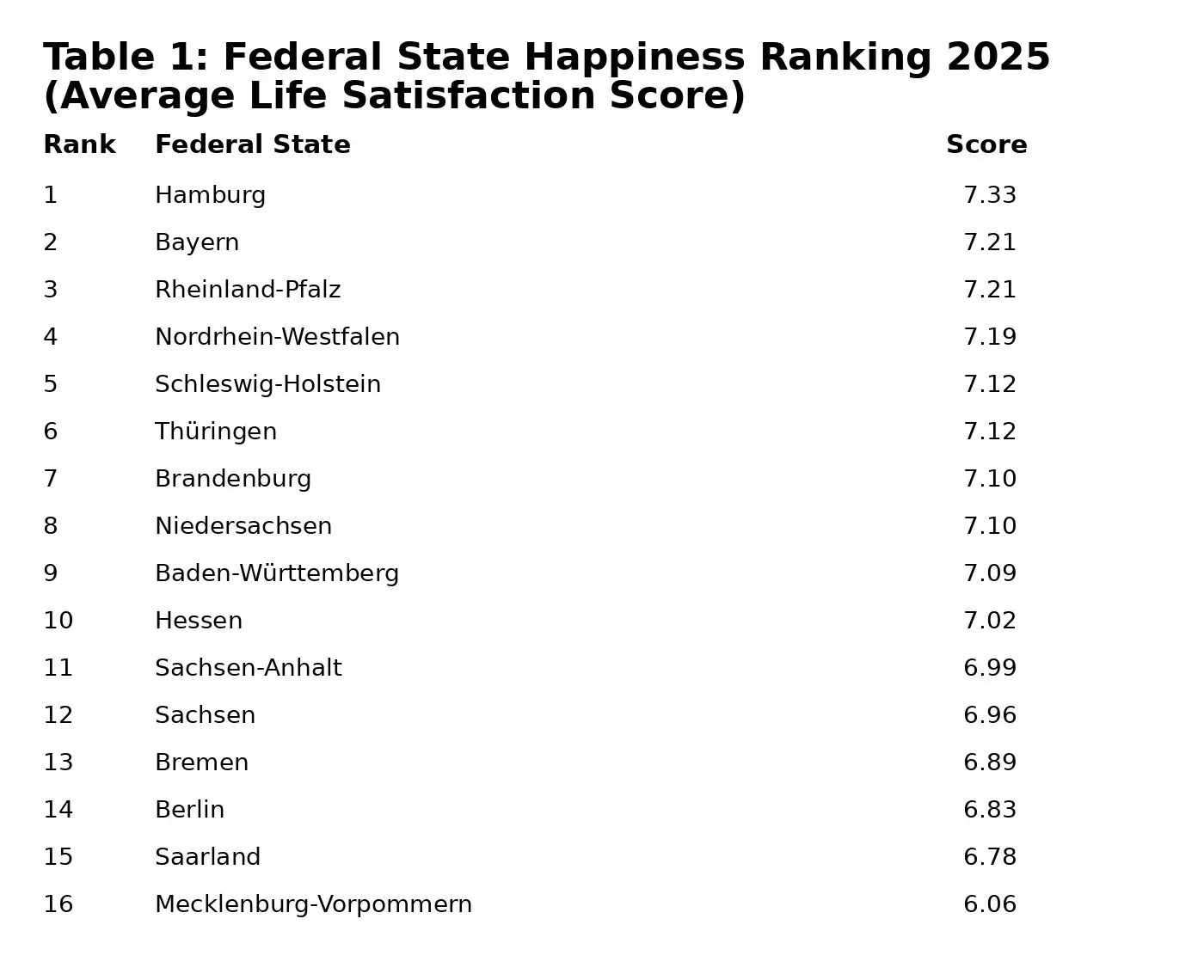
At the state level, Hamburg remains the happiest federal state, followed by Bayern, Rheinland-Pfalz, and Nordrhein-Westfalen. At the lower end of the ranking, Bremen, Berlin, Saarland, and Mecklenburg-Vorpommern continue to score below average. Regional differences are shrinking overall, as weaker regions gain slightly while top performers stagnate.
There are three surprises: Rhineland-Palatinate, after several years of below-average scores, has reached third place, achieving the level of life satisfaction one would expect given its above-average living conditions. Secondly, Thuringia has gained a significant 0.22 points, reaching a respectable sixth place. Thirdly, Schleswig-Holstein (7.12) in fifth place represents a negative surprise: For the first time since the COVID-19 pandemic, the long-time leader in the happiness ranking has lost ground in terms of life satisfaction and has thus fallen further behind.
The Glücksatlas distinguishes between subjective life satisfaction and objective living conditions, such as income, infrastructure, safety, and health. Some states, including Hamburg and Nordrhein-Westfalen, report higher happiness than their objective conditions would suggest. Others, such as Baden-Württemberg, Hessen, and Saarland, show the opposite pattern, with strong structural conditions but comparatively lower life satisfaction.
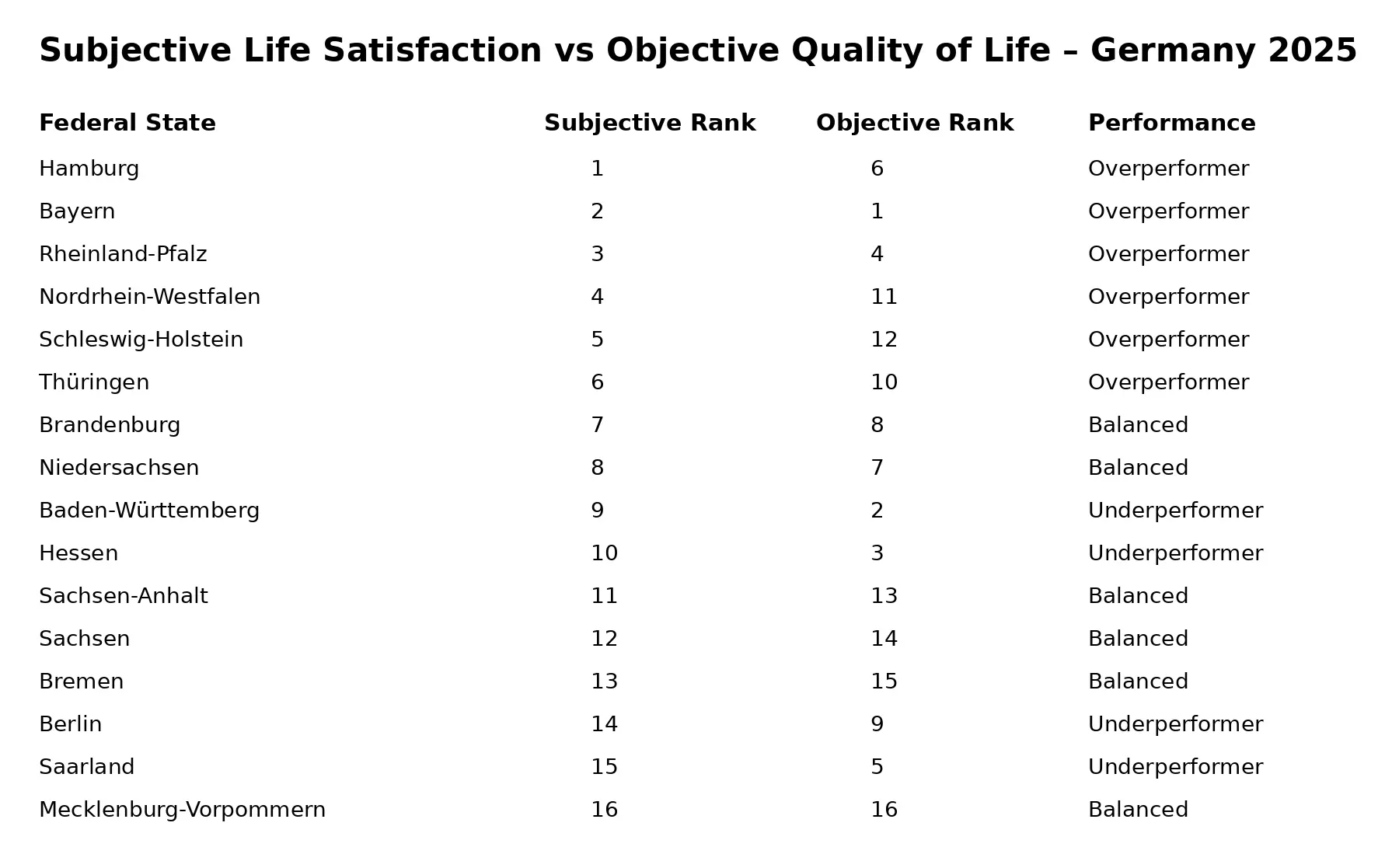
Together, these findings show that happiness in Germany in 2025 is shaped not only by measurable living standards, but also by perception, expectations, and social context.
From breaking news to thought-provoking opinion pieces, our newsletter keeps you informed & engaged.
By subscribing, you agree to our Terms & Conditions and Privacy Policy.


