


Educational opportunities in Germany are critically dependent on social background and gender, according to a new study. The Chancenmonitor, published Tuesday in Berlin by the ifo Institute and the association "Bild hilft - Ein Herz für Kinder," also found that boys are disadvantaged compared to girls. The Left party and the children's rights organization Save the Children called for strengthening child and youth welfare services and greater promotion of early childhood education.
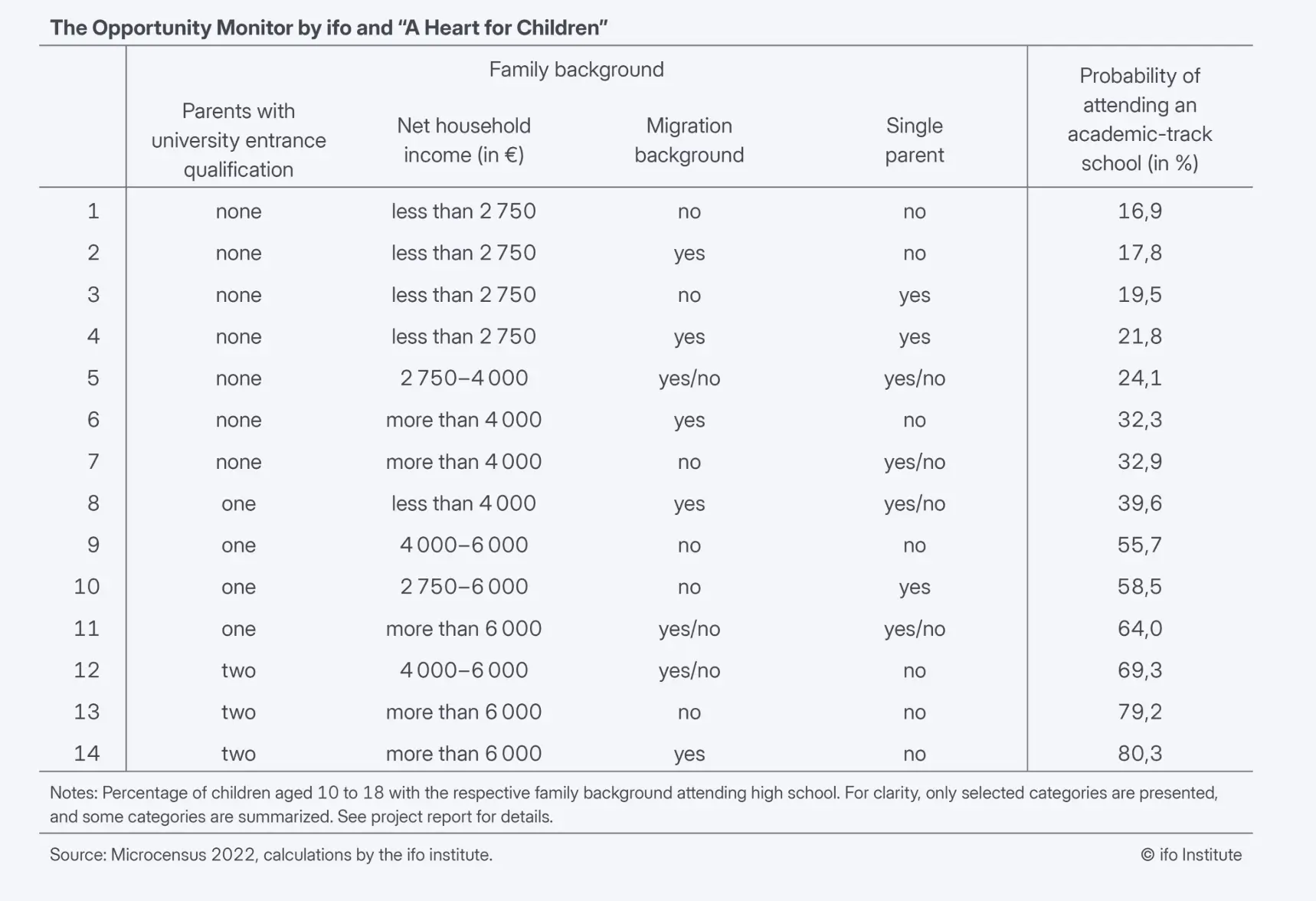
The probability of attending a gymnasium stands at only 16.9 percent in the most disadvantaged background group, compared to 80.3 percent in the most privileged group based on family background, according to the study. "Our analysis shows how strongly the chance of attending a gymnasium is determined by parental education and income," explained Ludger Wößmann, head of the ifo Center for the Economics of Education.
ifo researcher Vera Freundl called it "concerning" that boys have "systematically lower educational opportunities" than girls. "While 43.5 percent of girls attend a gymnasium, only 36.9 percent of boys do – a gap of 6.6 percentage points that runs through all social groups."
However, this gender gap to the detriment of boys is smaller in the highest education and income groups. According to the study, it increases during the school years and reaches 9.6 percentage points by ages 16 to 18. "The new Chancenmonitor thus documents multiple inequality in educational opportunities," stated Sarah Majorczyk, chairwoman of "Bild hilft - Ein Herz für Kinder."
The ifo experts also provide policy recommendations: To improve educational opportunities for socially disadvantaged groups, more early childhood education programs are needed, stronger family support, qualified teachers at schools with disadvantaged children, more free tutoring programs, later tracking of children into different school types, and more mentoring programs.
To improve opportunities for boys, the researchers recommend more male educators and teachers, greater attention to gender stereotypes in teaching and education, earlier promotion of reading skills, as well as more parental work and extracurricular measures to motivate boys toward education.
In the view of Left party parliamentary group leader Heidi Reichinnek, the study demonstrates the importance of early childhood education for children's development and equal opportunities. More than 300,000 daycare places are still missing "and the situation in daycare centers is catastrophic in many places, despite highly committed staff," stated Reichinnek. She called on Family Minister Karin Prien (CDU) to provide "the appropriate funds" for the next daycare quality law.
Save the Children stated that Germany cannot afford "to leave even one child behind" in times of skilled worker shortages, an aging population, and economic stagnation. Children who grow up in poverty have a significantly increased risk of also living in poverty as adults. "Stopping this negative spiral is one of the most important tasks of education and social policy."
Save the Children demanded a "comprehensive state strategy against child poverty." This must include child and youth welfare services as well as monetary social benefits. In their view, the subsistence minimum for children must be recalculated from the perspective of participation. Furthermore, important social support programs must not be cut.
The study utilizes data from nearly 68,000 children and adolescents aged 10 to 18, captured through the Mikrozensus 2022 – Germany's largest representative household survey. Their family background is measured through parental education level, household income, migration background, and single-parent status.
From breaking news to thought-provoking opinion pieces, our newsletter keeps you informed & engaged.
By subscribing, you agree to our Terms & Conditions and Privacy Policy.


