


Voting has begun in the Saxony-Anhalt state election. Polling stations opened at 8am on Sunday. Just under 1.7 million people in the state are eligible to cast a ballot. Minister President Sven Schulze is fighting for the CDU to be able to stay in government. In the polls, however, the AfD was well ahead.
Pre-election surveys did not point to an absolute majority for the party, which is classified by the state Office for the Protection of the Constitution as confirmed right-wing extremist and which is seeking to govern alone and to provide a minister president for the first time. None of the other parties wants to enter a coalition with the AfD.
The outgoing governing coalition of CDU, SPD and FDP no longer has a majority either. The FDP faces an anxious wait over whether it will return to the state parliament, and it could also be tight for the Greens. The BSW was polling below the five percent threshold. Forming a government without the AfD is therefore likely to prove difficult. One option would be a CDU-led minority government with one or two partners. As in Saxony and Thuringia, such a coalition would be dependent on cooperation with the Left Party.
The first projections are expected when polling stations close at 6pm. The vote in Saxony-Anhalt could have a signal effect for the elections in Berlin and Mecklenburg-Western Pomerania in two weeks' time, and for federal politics as well.

Ulrich Siegmund, the AfD's lead candidate, cast his vote in the Saxony-Anhalt state election this morning. The 35-year-old and his wife Julia arrived at a polling station in his hometown of Tangermünde on a Simson moped.
The AfD, classified as a confirmed right-wing extremist party by the state's domestic intelligence agency, is polling far ahead of the ruling CDU of Minister-President Sven Schulze. Siegmund has declared his election goal as "45 percent plus X".

The CDU's lead candidate, Minister President Sven Schulze, cast his vote in the morning in Magdeburg, where he lives, together with his wife Kati. The CDU is fighting to stay in government. In the polls, however, the AfD, classified as confirmed right-wing extremist, was ahead.
Voter turnout is shaping up to be significantly higher by midday. By 12:00 p.m. 34.72 percent of eligible voters had cast their ballots, according to the state election commissioner in Magdeburg. At the same point in 2021, during the last state election, the figure was only 22.4 percent.
The spectre of a far-right state government drew thousands of the AfD's opponents to rally on Saturday in Magdeburg, the regional capital, with banners saying "life is better without Nazis". "I'm very worried," demonstrator Laura Saalfeld told AFP. "Whatever the results, the atmosphere will change. Far-right sympathisers will show themselves more openly on the streets." Police were out in force in Magdeburg, due to fears of clashes after the results.
As of 2 p.m. voter turnout in the Saxony-Anhalt state election stood at 54.4 percent, state election commissioner in Magdeburg announced. That is twice the figure recorded at the last state election on 6 June 2021, when only 27.1 percent of eligible voters had cast their ballots by 2 p.m. The figure is based on random feedback from representative polling districts, as the state election commissioner explained. Postal votes are not yet included.
If the AfD does take the State Chancellery, it has already said what the opening weeks would look like. At a party conference in Magdeburg in July, top candidate Ulrich Siegmund set out a ten-point, hundred-day programme built around deportations of undocumented migrants, mandatory community service for asylum seekers, and scrapping the state treaty that underpins public broadcasting. Here's the full plan.
As of 4:00 p.m. on Sunday it stood at 65.3 percent. That was considerably higher than at the last state election on 6 June 2021, when only 41 percent of eligible voters had cast their ballots by 4:00 p.m.
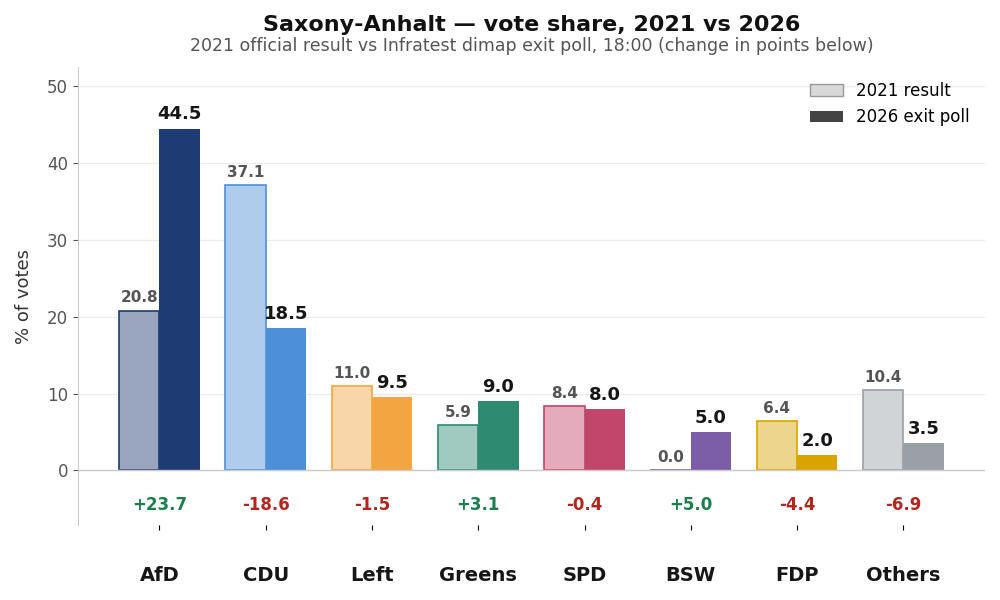
Germany's far-right AfD won key regional elections Sunday by a landslide with at least 44 percent of the vote in the eastern state of Saxony-Anhalt, said exit polls by two public broadcasters.
The AfD was far ahead of the centre-right CDU of Chancellor Friedrich Merz, which stood at 18.5 percent, but it was too early to say whether the far-right party would win an absolute majority, said public broadcasters ARD and ZDF.
From breaking news to thought-provoking opinion pieces, our newsletter keeps you informed & engaged.
By subscribing, you agree to our Terms & Conditions and Privacy Policy.


