


The latest population figures underline just how thin Germany's youngest adult cohort has become. According to the Federal Statistical Office (Destatis) in Wiesbaden, 8.3 million people living in Germany were between 15 and 24 years old at the close of 2025. That works out to exactly 10.0 percent of the total population, a share that has now been stuck at this historic floor since the opening years of the 2020s. The office published the data ahead of International Youth Day on 12 August 2026.
The contrast with earlier decades is striking. Young people accounted for their largest share of the German population during the first half of the 1980s, when the numerous birth cohorts known as the baby boomers were passing through their teens and early twenties.
In 1983, across the territory that makes up today's Federal Republic, 16.7 percent of residents fell into the 15-to-24 bracket. In practical terms, roughly one in six people back then was a young person, compared with one in ten today, a decline of nearly seven percentage points in four decades.
Destatis figures make clear that the current share would be even lower were it not for people who moved to Germany and the families they raised there. Among residents without an immigration background, only 8.5 percent were aged 15 to 24 in 2025. Among those with an immigration background, the figure stood at 12.2 percent.
The statistical office defines a person as having an immigration background if they themselves have immigrated since 1950, or if both of their parents have. Because the definition captures only arrivals from 1950 onwards, the children of those arrivals are structurally younger than the population at large, one reason the gap appears as wide as it does.
The pattern is sharpest among the second generation: 20.4 percent of people whose parents both immigrated were aged 15 to 24, and 20.0 percent of those with one immigrant parent fell into the same age range. Among immigrants themselves, by contrast, the share was 9.5 percent.
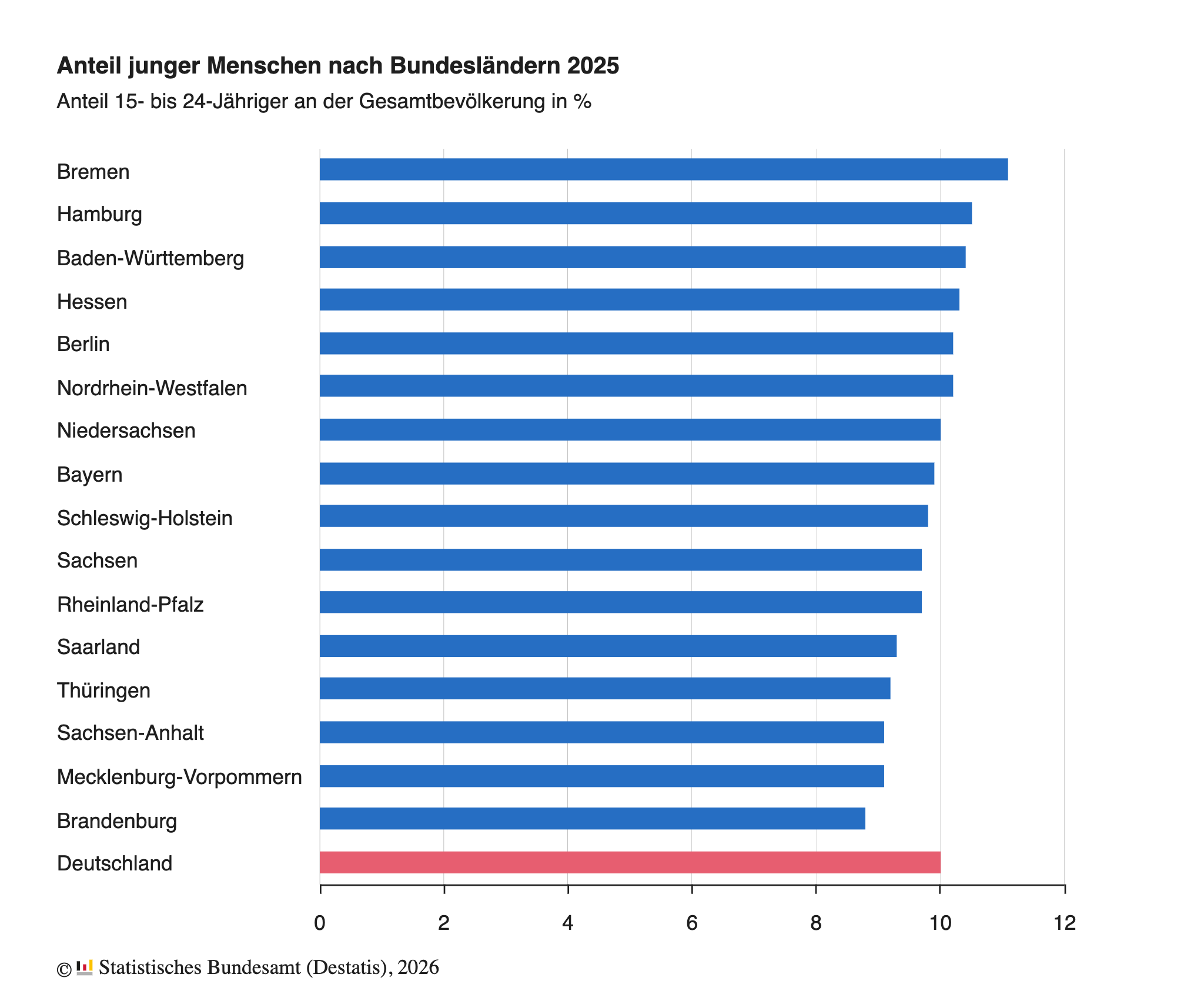
The national average conceals noticeable regional variation. The two city-states came out ahead, with Bremen recording 11.1 percent and Hamburg 10.5 percent. Baden-Württemberg matched the pattern among territorial states at 10.4 percent, putting all three above the national figure and giving the age group an above-average presence there.
Several eastern federal states sit on the other side of the average. Brandenburg registered 8.8 percent, while Mecklenburg-Western Pomerania and Saxony-Anhalt each came in at 9.1 percent. In all three, fewer than one in ten residents belonged to the 15-to-24 age group, leaving them below the level recorded for Germany as a whole.
Placed alongside its neighbours, Germany falls slightly short of the European benchmark. Data from Eurostat, the statistical office of the European Union, put Germany at 10.0 percent at the start of 2025, against an EU-wide average of 10.7 percent.
Ireland posted the highest proportion of 15-to-24-year-olds anywhere in the bloc at 12.7 percent, followed by Denmark and the Netherlands, which both recorded 12.2 percent. The smallest shares within the EU were recorded in Malta at 9.4 percent and Bulgaria at 9.5 percent. Germany's own reading of 10.0 percent therefore falls between those two ends of the range, below the bloc's average but above its lowest-ranked member states.
Taken together, the numbers describe a settled situation rather than a passing fluctuation. The 10.0 percent mark has held for several consecutive years, positioning Germany's youth share well below both its own historic peak and the current European norm.
From breaking news to thought-provoking opinion pieces, our newsletter keeps you informed & engaged.
By subscribing, you agree to our Terms & Conditions and Privacy Policy.


