


A growing number of young adults in Germany are staying in the family home well into their twenties. According to figures released by the Federal Statistical Office (Destatis) in Wiesbaden, roughly 30 percent of 25-year-olds were still living with their parents in 2025. This marks a modest increase compared with the previous three years, when the figure held steady at 28 percent between 2022 and 2024.
The data, drawn from preliminary results of the microcensus, points to a gradual shift in how long young Germans remain in their parental household before establishing independent living arrangements.
The statistics reveal a clear gender gap in living arrangements among young adults. More than a third of 25-year-old men, 36 percent, were still residing with their parents in 2025, compared with just under a quarter of women in the same age group, at 23 percent.
This gender divide persists as young adults grow older, even though the overall share of those living at home declines steadily with age. Among 30-year-olds, 13 percent of men and 7 percent of women still lived in their childhood home. By age 40, these figures had fallen further to 5 percent of men and 2 percent of women.
According to Destatis, most young adults still living in the parental home are employed. Among 25- to 34-year-olds still residing with their parents, 77 percent were employed. Of this employed group, 80 percent worked full-time while 20 percent held part-time positions. Six percent were classified as unemployed, and the remaining 17 percent were outside the labor force.
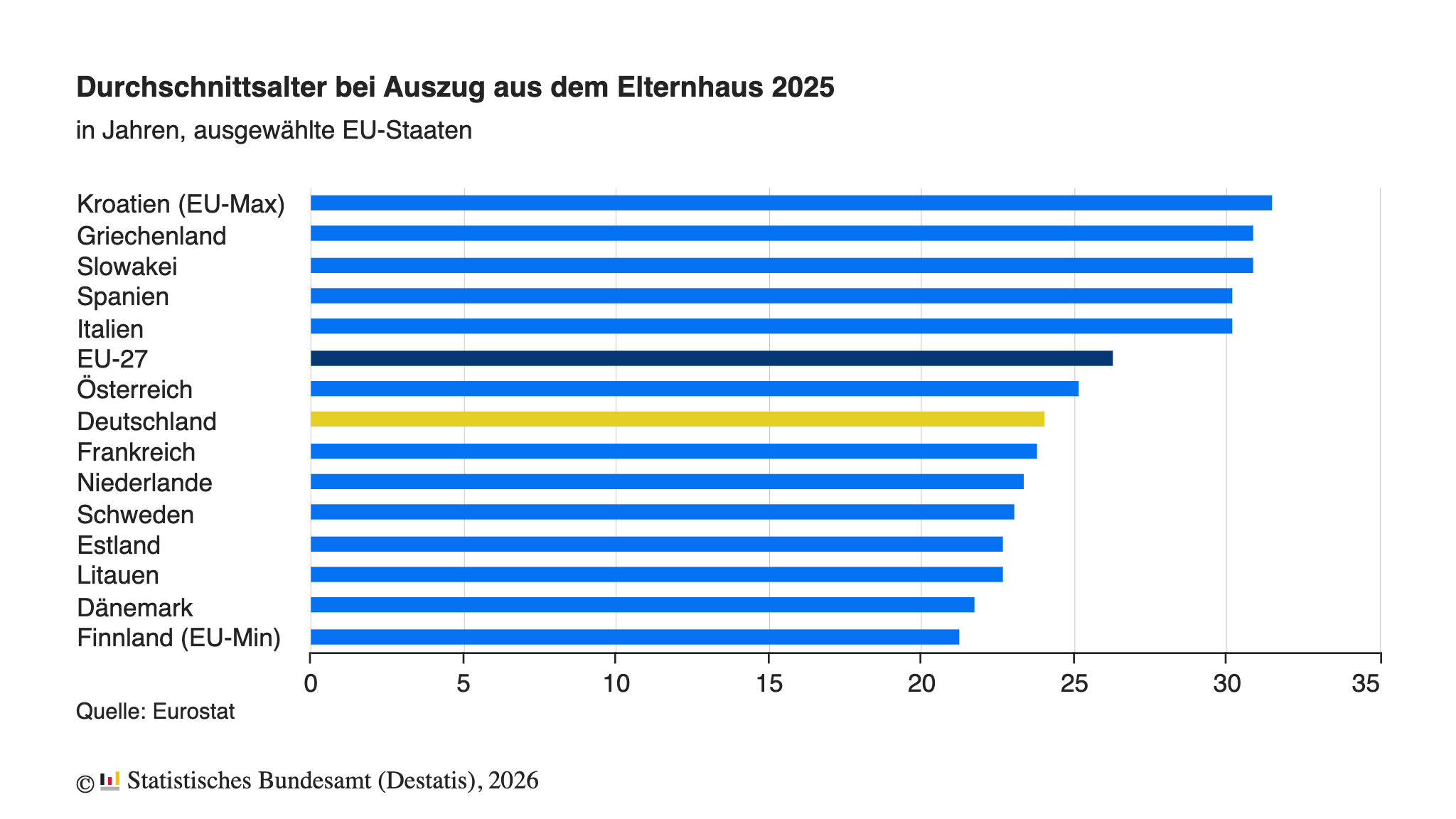
When compared with the rest of Europe, young Germans tend to leave the parental home relatively early. The average age of leaving home in Germany stood at 24.1 years in 2025, notably lower than the European Union average of 26.3 years, according to calculations from the EU statistical agency Eurostat.
Northern European countries recorded the earliest average departure ages. Finland led with an average of just 21.3 years, followed by Denmark at 21.8 years, and both Lithuania and Estonia at 22.7 years. By contrast, southern and eastern European nations saw young people staying home considerably longer. Croatia recorded the highest average departure age in the EU at 31.5 years, followed closely by Greece and Slovakia at 30.9 years each, and Spain and Italy, both at 30.2 years.
A consistent pattern across nearly the entire European Union, with Malta as the sole exception, shows daughters leaving the parental home earlier than sons. In Germany, women left home on average at 23.3 years, compared with 24.8 years for men. Across the EU as a whole, the average age of leaving home was 25.5 years for women and 27.2 years for men.
From breaking news to thought-provoking opinion pieces, our newsletter keeps you informed & engaged.
By subscribing, you agree to our Terms & Conditions and Privacy Policy.


