


Indian citizens working full-time in Germany earn about €1,000 a month more than German citizens. Workers from Somalia and Iraq earn roughly €1,600 a month less. The figures were compiled by the Federal Employment Agency and published in August 2026, in the government's answer to a set of questions from the AfD parliamentary group about how far foreign workers trail Germans in pay. They cover around 40 nationalities. What follows are the findings that stand out; the report contains a great deal more.
First, who is counted: people in full-time jobs paying into the social security system, employed as of 31 December 2025. That is around 21.6 million people. Part-time workers and apprentices are excluded. Within that group, the median pay for German citizens was €4,396 a month before tax, half earned more than that, half less. For foreign citizens the median was €3,358.
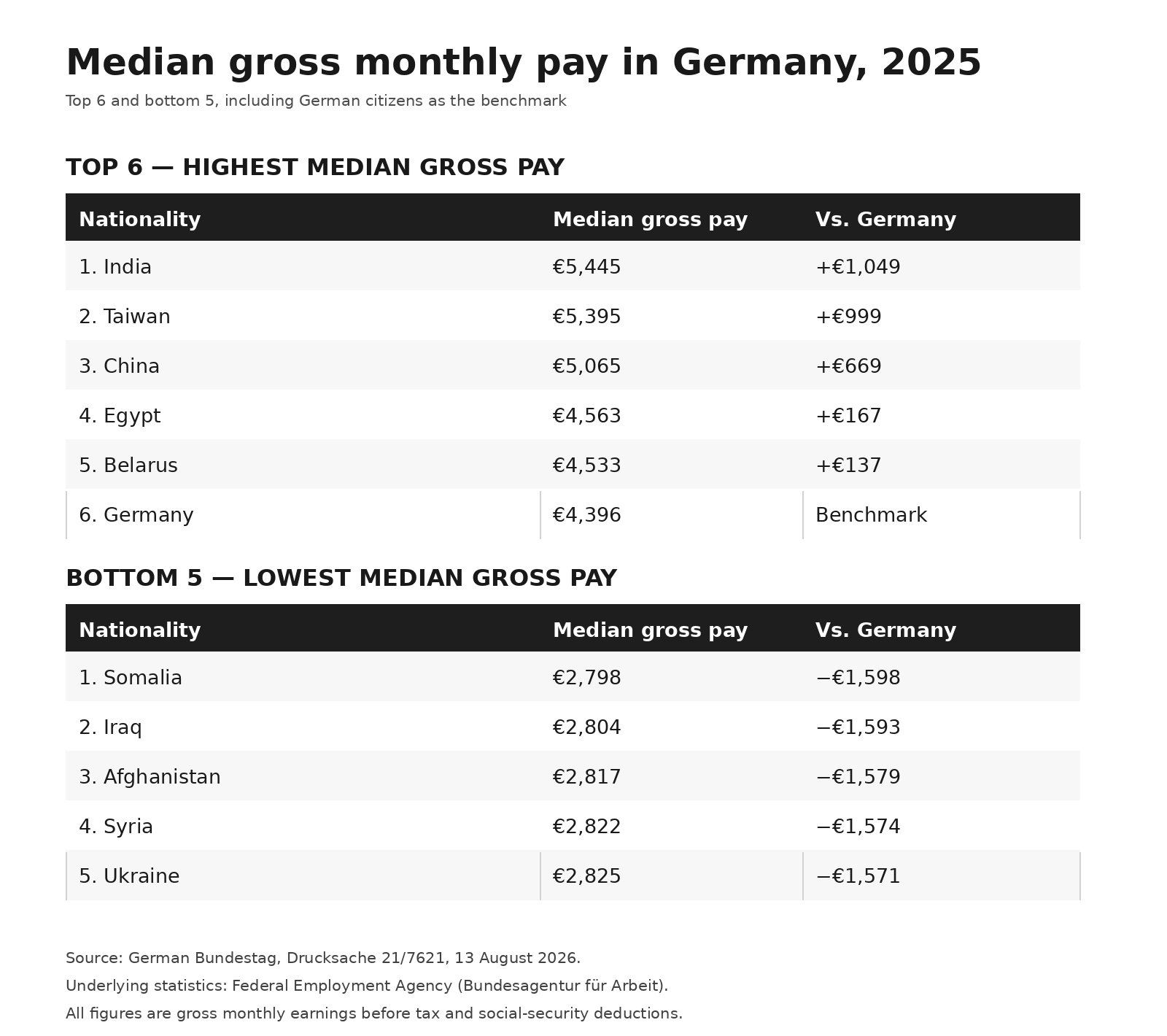
The difference is €1,038 a month, or 24 per cent. But that overall figure masks wide differences between nationalities.
Indian citizens have the highest median gross monthly pay in the report at €5,445, around €1,049 more than German citizens. Taiwan (€5,395) and China (€5,065) follow, while Somalia (€2,798) and Iraq (€2,804) are at the bottom. Five nationalities have a higher median gross monthly pay than German citizens. The gap between the highest- and lowest-paid nationalities is about €2,600 a month, more than twice the €1,038 gap between German and foreign citizens overall.
All figures are gross monthly pay, before tax and social security deductions. German labour statistics are reported this way; take-home pay is considerably lower and depends on tax class, marital status and children.
Germany's low-earnings threshold was €2,811 a month in 2025, defined as two-thirds of the national median. Across all foreign citizens, 30.6 per cent earn less than that, against 12.3 per cent of Germans. The spread between nationalities is again very wide. Only Taiwan and China have a smaller share below the threshold than German citizens do.
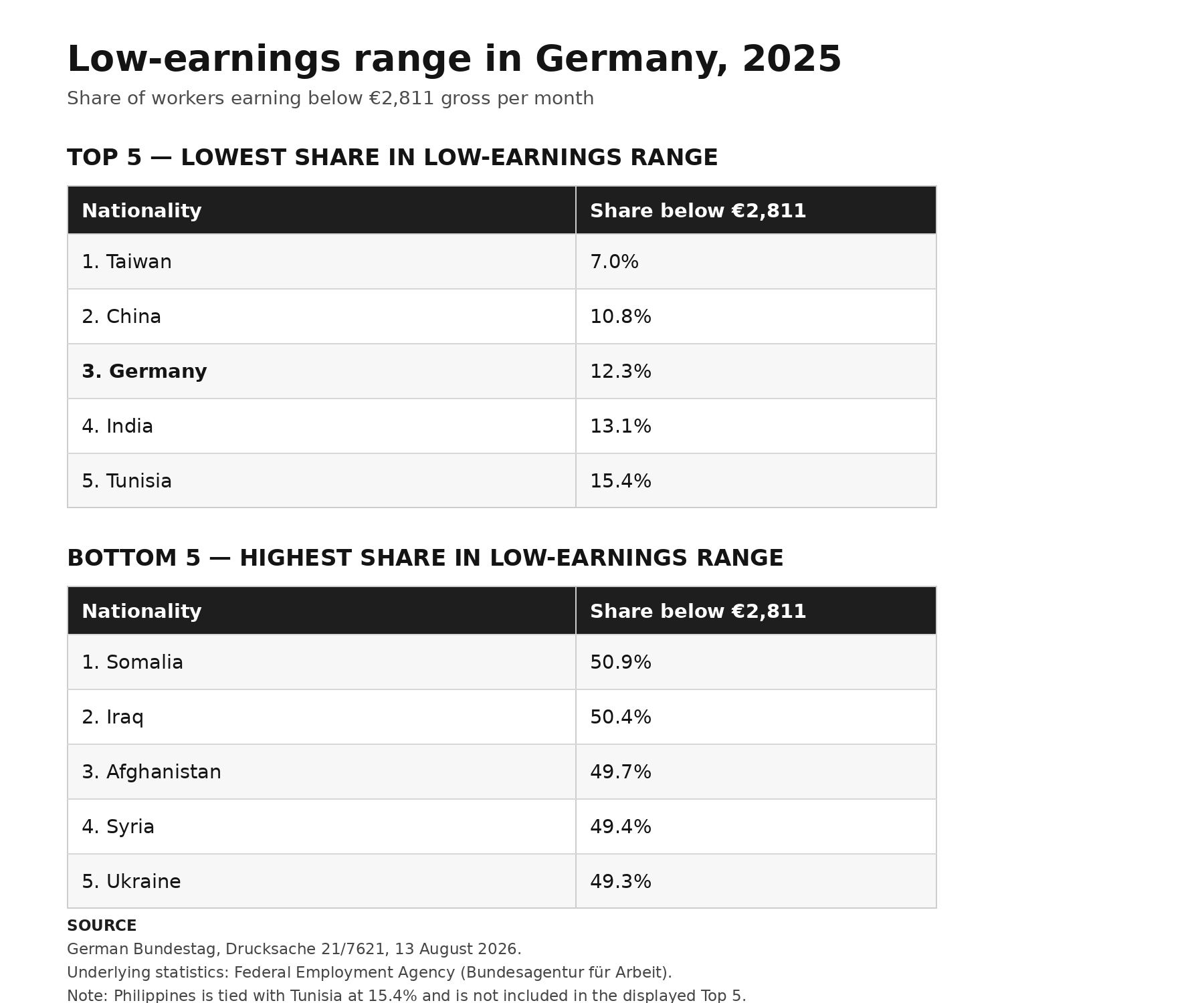
A larger share of Indian citizens than Germans earn below the €2,811 threshold, 13.1 per cent against 12.3 per cent. Yet Indian citizens have the highest median pay of any nationality in the report. Both facts come from the same cause: the kind of work Indian citizens do in Germany.
Around 62 per cent of them are in the two highest job categories, specialist and expert, against 37 per cent of Germans. These are the best-paid roles in the country, the German median alone is €5,240 in specialist jobs and €6,623 in expert jobs, against €3,200 at the lowest level. A workforce weighted that heavily towards senior roles produces a high median.
At the other end, about 12,000 of the 110,832 Indian workers are in the lowest job category, and they are paid poorly: 69.7 per cent earn less than the German median for that category. In qualified roles, the figure is about half, the same proportion as Germans.
The report makes one further comparison across job categories. Around 790,000 foreign workers in skilled jobs, roughly 44 per cent, earn less than the €3,200 median pay of German workers in the lowest job category. In other words, nearly half of foreign workers in skilled jobs earn less than the typical German worker in the lowest job category.
One calculation in the report concerns everyone. The government worked out what someone must earn to receive, after 45 years of contributions, a pension above the level of basic income support in old age. For 2025 the answer was €2,672 a month gross. About 2.7 million people of the 21.6 million in the group counted earn less than that, one in eight. Of them, 1.74 million are German citizens, 9.8%
This is a theoretical calculation, not a prediction that these workers will be poor in retirement. The report assumes 45 years of employment and excludes the basic pension supplement when making the calculation.
Two limits matter, on top of the narrow group being counted. "Foreigner" here means passport, not background. Anyone who has taken German citizenship counts as German throughout. And nothing is held constant, not age, industry, region, years in the country or language. The tables show that a gap exists and where it clusters. They cannot show whether it comes from workers being paid less for the same job, or from being channelled into worse jobs in the first place. That distinction is the whole argument. This report does not settle it.
Watch the video to see how foreign workers’ salaries in Germany compare with those of German citizens, and which nationalities earn the most and least.
From breaking news to thought-provoking opinion pieces, our newsletter keeps you informed & engaged.
By subscribing, you agree to our Terms & Conditions and Privacy Policy.


