


Hamburg has retained its position as Germany's most digitalized state, according to the latest federal state index released by Bitkom, Germany's digital association, on Wednesday in Berlin. The city-state achieved a score of 70.3 out of a possible 100 points, demonstrating its continued leadership in digital infrastructure and innovation across the country.
The federal state index, known as the Länderindex, serves as a comprehensive measurement tool for assessing digitalization progress across all German states. This annual study provides crucial insights into how different regions are performing in their digital transformation efforts, allowing for meaningful comparisons and identification of best practices that can be adopted nationwide.
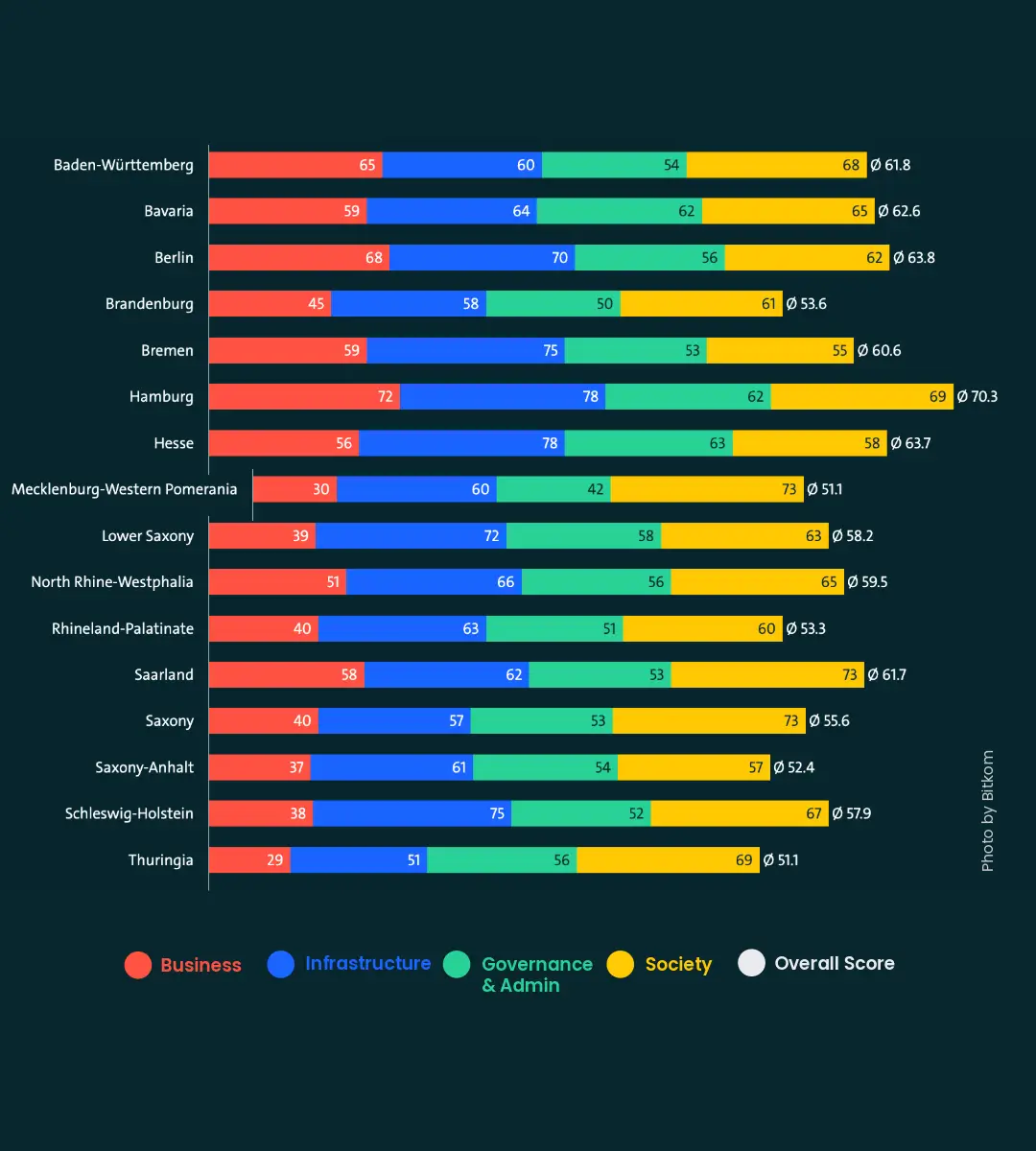
The ranking system evaluates states across four fundamental pillars that together define digital readiness and advancement. These categories include the digital economy, which measures business innovation and technology adoption in the commercial sector.
Digital infrastructure assessment examines the availability and quality of technological foundations such as broadband connectivity and mobile networks. The digital society component evaluates how citizens engage with and benefit from digital services and technologies. Finally, governance and digital administration measure how effectively government services have been modernized and made accessible through digital channels.
To compile this comprehensive index, Bitkom's experts analyze various official statistics and research studies while simultaneously surveying state governments about their digital initiatives and infrastructure investments. Additionally, the methodology includes gathering insights from approximately 5,600 citizens across Germany.
This citizen feedback component ensures that the assessment reflects not only governmental initiatives and infrastructure development but also the actual public experience with digital services and technologies in daily life.
The capital city of Berlin secured second place in the rankings with 63.8 points, followed closely by Hesse with 63.7 points. These three states have established themselves as the frontrunners in Germany's digital transformation, setting benchmarks for other regions to follow.
At the opposite end of the spectrum, Saxony-Anhalt, Mecklenburg-Western Pomerania, and Thuringia occupied the bottom positions. Saxony-Anhalt scored 52.4 points, while both Mecklenburg-Western Pomerania and Thuringia achieved 51.1 points each, highlighting a substantial digital gap between Germany's leading and trailing states.
The most striking development in this year's rankings was Saarland's dramatic improvement. The southwestern state climbed to sixth position, a significant leap from its twelfth-place ranking in the previous 2024 assessment. This remarkable progress demonstrates that meaningful digital advancement is achievable within a relatively short timeframe.
According to Bitkom, Saarland's success primarily stems from its exceptional performance in the education sector. The state has implemented mandatory computer science instruction across all school types, with students receiving at least six compulsory hours of informatics education. Furthermore, Saarland has achieved outstanding results in providing gigabit connectivity to educational institutions, recording top marks in school internet infrastructure.
Bitkom President Ralf Wintergerst emphasized the significance of Saarland's achievement, noting that it serves as a compelling example for other states. "Saarland demonstrates exemplarily that digital progress does not depend solely on size and financial resources," Wintergerst stated. His comments underscored an important message for policymakers nationwide.
The Bitkom president further explained that states willing to make targeted investments in digital education and establish clear political priorities can rapidly accelerate their digitalization efforts. This observation suggests that strategic planning and focused resource allocation can overcome traditional limitations of smaller budgets or geographical constraints in achieving digital transformation goals.
From breaking news to thought-provoking opinion pieces, our newsletter keeps you informed & engaged.
By subscribing, you agree to our Terms & Conditions and Privacy Policy.


