


Waiting months for a residence permit appointment. Filling out government forms that only exist on paper. Getting turned away at a café because the card reader is broken and you don't have cash. Or living in a city for years while your circle of friends stays made up almost entirely of other foreigners, because breaking into local social circles never quite happens. If any of that sounds familiar, you're not alone, according to newly released international rankings for 2026, Germany placed 30th out of 31 countries for expats, ahead of only Norway, dragged down almost entirely by problems like these.
Germany placed 30th overall out of 31 countries evaluated, part of a European cluster dominating the bottom of the table, eight of the ten lowest-ranked destinations this year are European. The bottom ten, in order: Switzerland, Austria, Italy, Czechia, Sweden, Canada, the UK, Türkiye, Germany, and Norway in last place.
Here's what dragged Germany down:
This isn't a one-off. Germany has ranked near the bottom of the Expat Insider survey for years, with the same complaints resurfacing each time: paper-based bureaucracy that requires in-person visits rather than online forms, a digital public sector that lags behind comparable economies, a housing market that's difficult to break into, and a language and social barrier that leaves many newcomers feeling like permanent outsiders rather than settled residents.
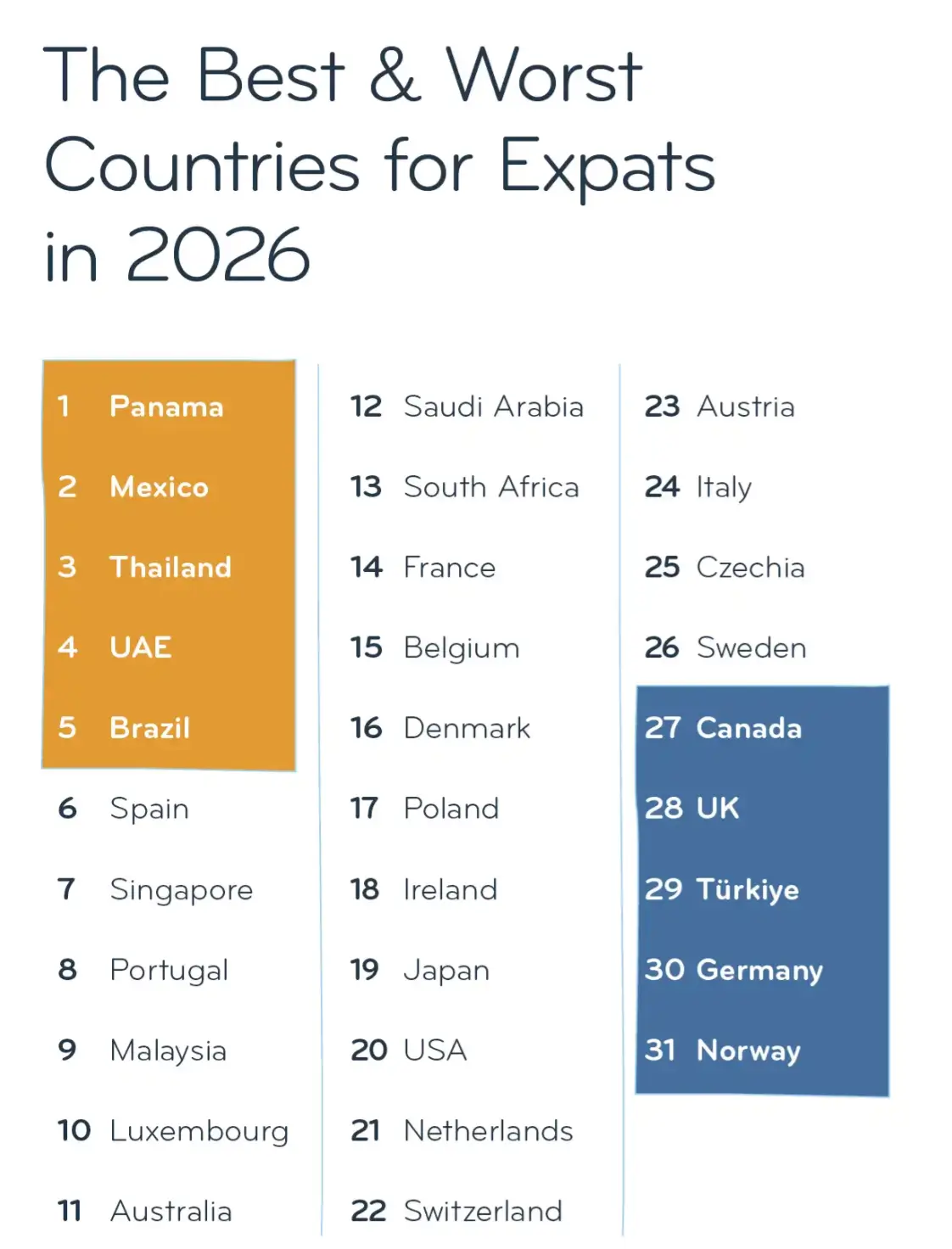
Panama topped the ranking for the third year running, with an 87% expat satisfaction rate and a third of its expats wanting to stay forever. The full top ten for 2026: Panama, Mexico, Thailand, the UAE, Brazil, Spain, Singapore, Portugal, Malaysia, and Luxembourg. Thailand had the happiest expats overall, with 86% saying they were happy there. Mexico ranked first specifically for Ease of Settling In, thanks to how easy expats found it to make friends and feel welcome.
Norway's expats reported the lowest overall satisfaction in the survey, driven mainly by difficulty settling in and making friends. Germany's problem is different: practical, administrative friction, compounded by, not caused by, social and language barriers.
For anyone considering a move to Germany, the message is less "don't go" than "go in prepared." The jobs, salaries and social benefits are still there. What isn't guaranteed is a smooth landing, expect paperwork, expect delays, and expect that making local friends takes real effort. Until public administration catches up with the rest of the economy, Germany looks set to stay near the bottom of the table.
InterNations, the world's largest expat community, released its Expat Insider 2026 report in Munich on 23 July 2026. The study drew on responses from close to 8,000 expats representing 162 nationalities, who rated their experience living abroad in 31 countries across five core indices:
For a country to be included at all, at least 50 of its resident expats had to complete the survey. The fieldwork ran from 1 February to 31 March 2026.
From breaking news to thought-provoking opinion pieces, our newsletter keeps you informed & engaged.
By subscribing, you agree to our Terms & Conditions and Privacy Policy.


