


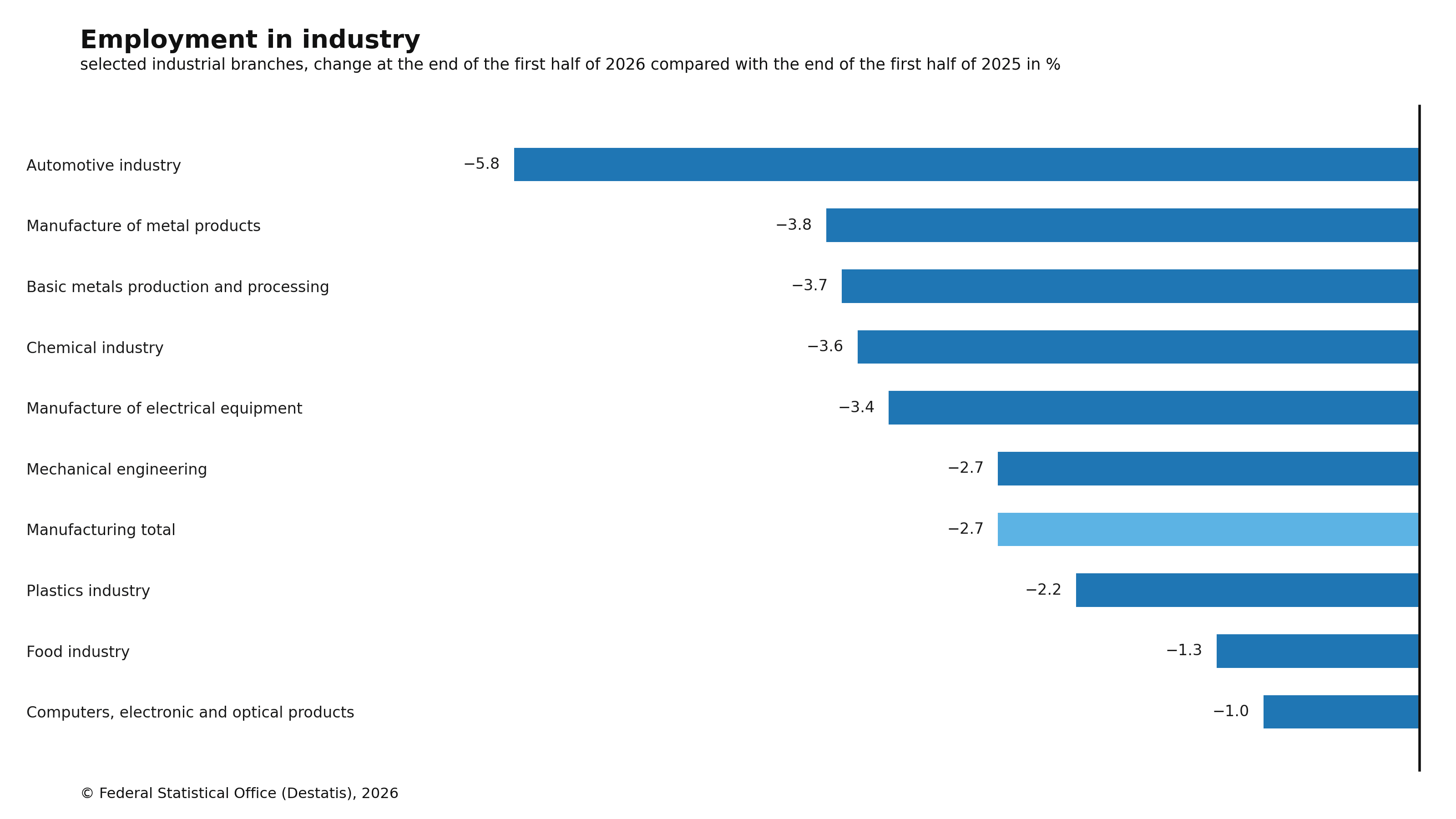
Germany's industrial sector has been shedding jobs, and nowhere have the cuts been deeper than in the automotive industry. By the end of the first half of 2026, the sector employed 42,300 fewer people than a year earlier, according to figures from the Federal Statistical Office (Destatis) in Wiesbaden. That amounts to a decline of 5.8 percent, steeper than in any other large industrial branch with more than 200,000 employees.
With 691,500 people on the payroll, employment in the German automotive industry has hit a fresh low: at no point since 2005 have fewer people worked in the sector. Even so, it remains the country's second-largest industrial branch by headcount, behind mechanical engineering, which employed 905,900 people at the end of the first half of 2026.
For comparison, manufacturing as a whole employed 5.29 million people, a drop of 144,100, or 2.7 percent, within twelve months.
Both vehicle manufacturers and suppliers of parts and accessories reduced headcount over the period. The one exception within the automotive industry was the segment producing bodies, coachwork and trailers, where employment rose.
Manufacturers of motor vehicles and vehicle engines employed a total of 429,200 people at the end of the first half of 2026, 6.1 percent fewer than a year earlier. Among suppliers producing parts and accessories for motor vehicles, employment fell by 7.6 percent to 219,500. In the smaller supplier segment covering bodies, coachwork and trailers, the workforce grew by 10.0 percent to 42,800.
Suppliers based outside the automotive industry, tyre manufacturing and retreading, for example, were not included in the analysis.
The automotive industry was not alone in cutting jobs; employment declined across Germany's other large industrial branches as well. In the manufacture of metal products, the workforce shrank by 3.8 percent within a year to 471,700 by the end of the first half of 2026. Basic metal production and processing recorded a 3.7 percent decline over the same period, down to 207,200.
Losses were also above average in the chemical industry, where employment fell 3.6 percent to 312,000, and in the manufacture of electrical equipment, down 3.4 percent to 374,500. Mechanical engineering shed 2.7 percent of its workforce in twelve months, matching the industry-wide average, leaving around 905,900 people employed at the end of the first half of 2026.
Declines were below average in the plastics industry, down 2.2 percent to 311,800, the food industry, down 1.3 percent to 503,400, and the manufacture of computers, electronic and optical products, down 1.0 percent to 307,100.
From breaking news to thought-provoking opinion pieces, our newsletter keeps you informed & engaged.
By subscribing, you agree to our Terms & Conditions and Privacy Policy.


