


The Left Party (Die Linke), led by top candidate Elif Eralp, has won Berlin’s parliamentary election, according to projections from German broadcasters ARD and ZDF. The party secured between 24.8% and 25.8% of the vote, comfortably finishing ahead of the governing Christian Democratic Union (CDU).
The CDU, led by Stefan Evers, received around 20% of the vote, placing second. For The Left, the result marks a historic milestone, delivering its strongest performance ever in a Berlin state election and roughly doubling its support compared with the 2021 vote.
The election results indicate a fragmented political landscape, with several parties gaining representation in the Berlin House of Representatives.
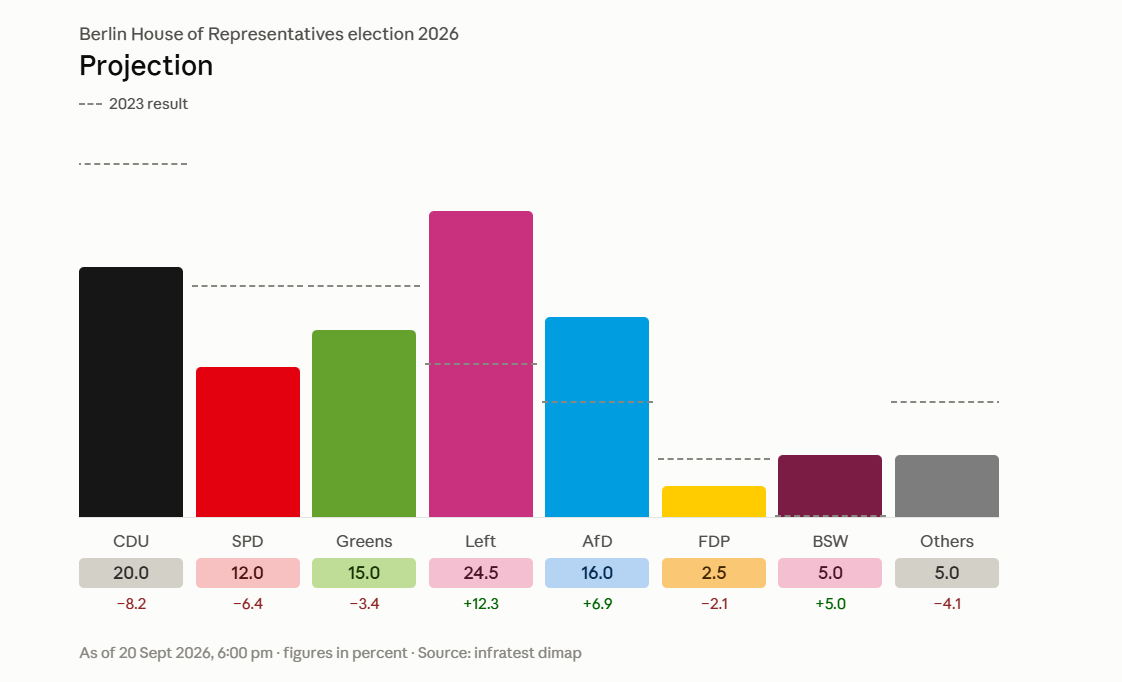
According to the latest projections:
The close race around the 5% threshold means the final composition of parliament could still depend on the official vote count.
Based on current projections, The Left is expected to become the largest parliamentary group, securing between 36 and 43 seats.
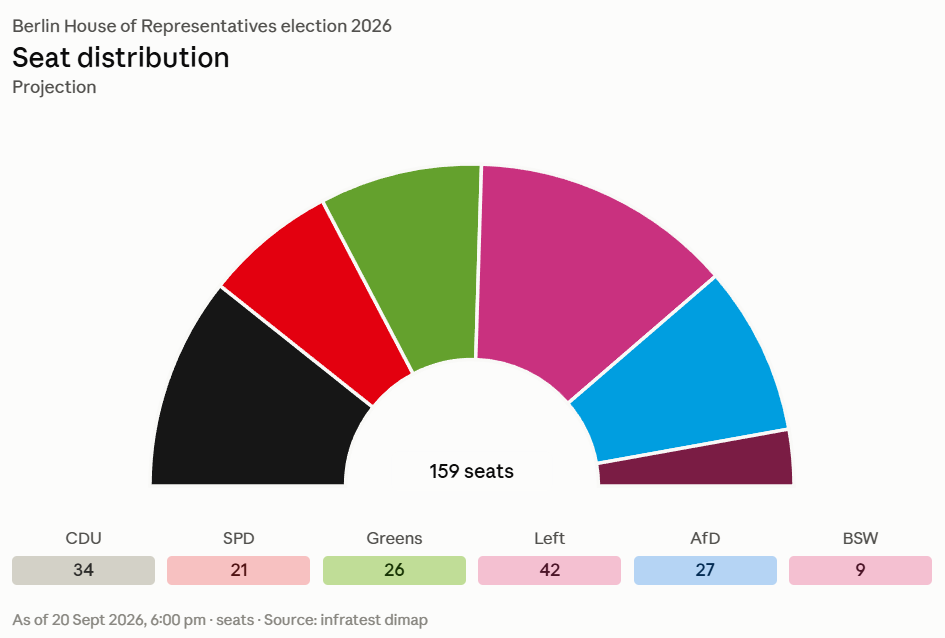
Projected seat distribution:
These numbers position The Left at the center of coalition negotiations and potential government formation.
The election result opens the door to multiple governing alliances.
A left-leaning coalition consisting of The Left, Greens and SPD could achieve a parliamentary majority. At the same time, a CDU-Greens-SPD alliance may also have enough seats to form a government.
With no single party close to an outright majority, coalition talks are expected to determine Berlin’s political direction for the coming years.
One of the election’s most notable developments was the sharp increase in voter participation. According to ZDF, 72.0% of eligible voters cast their ballots, significantly higher than the 62.9% turnout recorded in 2023.
The strong turnout reflects high public engagement in an election that could reshape Berlin’s political landscape and influence debates on housing, public services, social policy, and the city’s future development.
The 2026 Berlin election represents a major political shift. The Left’s historic victory, coupled with increased voter participation and multiple coalition possibilities, has reshaped the city’s balance of power. With coalition negotiations set to begin, attention now turns to which parties can build a stable majority and lead Germany’s capital through its next political chapter.
From breaking news to thought-provoking opinion pieces, our newsletter keeps you informed & engaged.
By subscribing, you agree to our Terms & Conditions and Privacy Policy.


