


The far-right Alternative for Germany (AfD) opened its annual party congress in Erfurt on Saturday, with co-leader Tino Chrupalla using his opening address to project party unity and confidence in future electoral wins, even as roughly 20,000 demonstrators tried to shut the event down through citywide blockades.
Welcoming delegates to the Erfurt exhibition halls, Chrupalla declared that the AfD would keep winning and suggested the party could soon govern alone in parts of eastern Germany once upcoming state elections are held, calling that outcome the right response to what he described as opponents of democracy who had tried to stop the congress from taking place.
Chrupalla devoted much of his opening speech to emphasising cohesion within the leadership, describing his partnership with co-chair Alice Weidel as an unusually successful pairing rarely seen in German politics and insisting the two remained united in their commitment to the country. He said the party intended to carry that same unity forward to the nation, framing the country's interests as coming before the party and the party before any individual.
Both Chrupalla and Weidel are seeking re-election at the congress, and delegates are also set to elect a completely new federal executive board, as required periodically under party rules. Chrupalla told delegates that only those who had demonstrated genuine achievement should be entrusted with high responsibility, a standard he said should apply equally to the national board as to a national sports team.
He also pushed back on reports suggesting the congress could see a power struggle orchestrated by internal rivals, dismissing talk of an impending showdown and insisting the party was more united than ever before. He added that newly elected board members should integrate into what he called the party's successful ongoing work rather than pursue an overhaul, describing the outgoing executive board as the most successful in the party's history.
Chrupalla further argued that the AfD wanted to present itself as a unifying rather than a divisive force, saying the party's goal was for everyone in Germany to eventually feel part of a shared "we." He said other parties would need to accept AfD election victories as part of the democratic process, calling elections the true celebration of democracy.
Addressing the demonstrations directly, Chrupalla accused protesters of opposing democratic decision-making while believing they alone held a claim to democracy. He told them that the current democratic system belonged to them just as much as to the AfD, and characterised holding a party congress as a legally guaranteed right. He also described the demonstrators as the last effort of the AfD's political rivals to stop the party's rise.
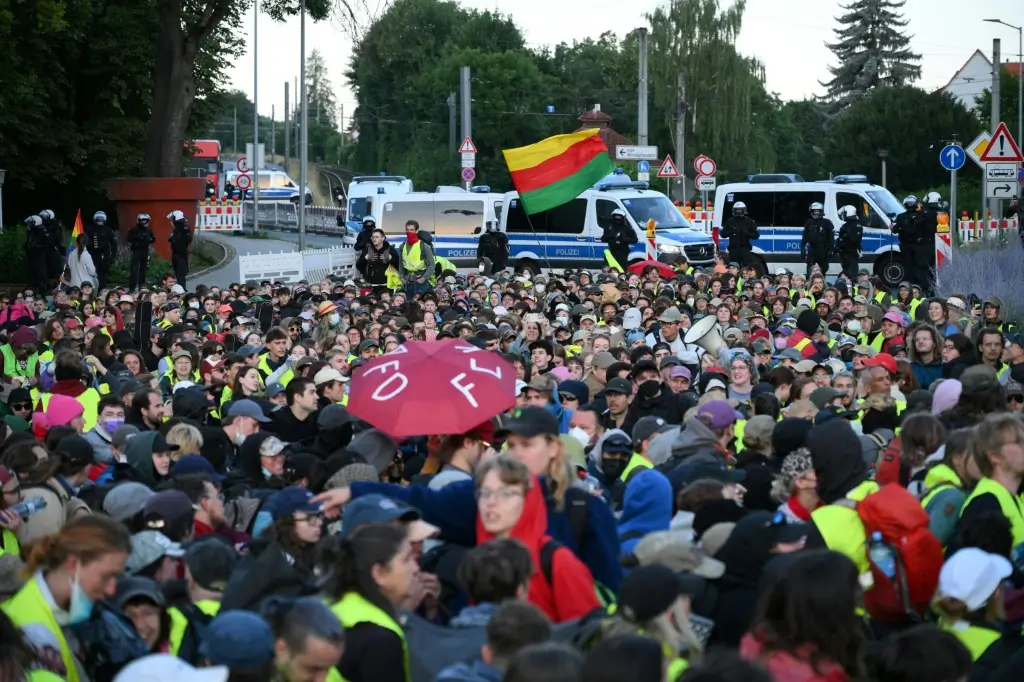
Police estimated the crowd opposing the congress at around 20,000 people, organised under a coalition calling itself "Widersetzen" ("Resistance"), which had set out to prevent the congress from happening entirely through blockades. Protesters cut off major roads into the city, with some activists rappelling from a motorway bridge to disrupt traffic, while other groups staged sit-in blockades across the city centre and glued themselves to tram tracks in a central square.
One demonstrator, 19-year-old Lene Krug from nearby Gera, told AFP the protest was meant to send a signal against Germany's rightward political shift, describing the AfD as an anti-democratic party that spreads hatred. Another protester, identified only as Ella, invoked Germany's Nazi-era history and argued that mainstream democratic parties should move to ban the AfD.
German weekly Der Spiegel reported that internal police documents estimated up to 2,500 protesters were expected to arrive prepared for violence. While early demonstrations were largely peaceful, minor scuffles broke out between activists and the large police presence deployed for the event. Despite the blockades, the first AfD delegates had already reached the Erfurt exhibition halls by bus overnight before the road closures began, allowing the congress to open on schedule.
Some observers have noted that the congress coincides with the 100th anniversary of a Nazi party conference held in nearby Weimar, a connection the AfD rejects as coincidental. Critics of the party continue to point to AfD figures downplaying Nazi-era crimes and to alleged links with banned right-wing extremist organisations.
Chancellor Friedrich Merz has made countering the AfD's rise a policy priority, even as other parties continue to refuse cooperation with it. The AfD, meanwhile, presents itself as a conservative alternative filling the space once occupied by Merz's Christian Democrats before migration policy changes under former chancellor Angela Merkel a decade ago.
The party is now aiming for its first taste of governing power, with state elections approaching in Germany's former communist east, historically its strongest region. Polling suggests the AfD could secure an outright majority in Saxony-Anhalt's elections in September. Nationally, the party has remained at or near the top of opinion polls since last year's federal election, in which it finished second with 20 percent of the vote.
Forsa polling institute head Manfred Guellner said he had not expected a radical right-wing party to become Germany's strongest political force within his lifetime, attributing part of the AfD's growth to public dissatisfaction with the current government rather than purely ideological support.
From breaking news to thought-provoking opinion pieces, our newsletter keeps you informed & engaged.
By subscribing, you agree to our Terms & Conditions and Privacy Policy.


