


With around a week and a half to go before the state election in Saxony-Anhalt, the lead candidates of the AfD and the CDU delivered a debate that was at times fiercely heated. State Premier and CDU lead candidate Sven Schulze and his AfD challenger Ulrich Siegmund accused each other of political failure on Wednesday evening on the MDR programme "Fakt ist!", broadcast from Magdeburg. The AfD has "no concept for the future of Saxony-Anhalt", for instance on the creation of jobs, Schulze said.
He, by contrast, was working for the people of his state as head of government. "I don't just talk, I deliver," Schulze said.
Siegmund countered that his party did in fact have a "clear plan" for the state. Among other things, the AfD wants to "reorganise" migration, which would free up funds for other investments, such as in hospitals. "We will write history," the AfD politician said, with a view to his party's declared aim of forming a single-party government with him as state premier. Saxony-Anhalt, he said, is "the beginning of a political change in Germany". The two politicians repeatedly cut across each other.
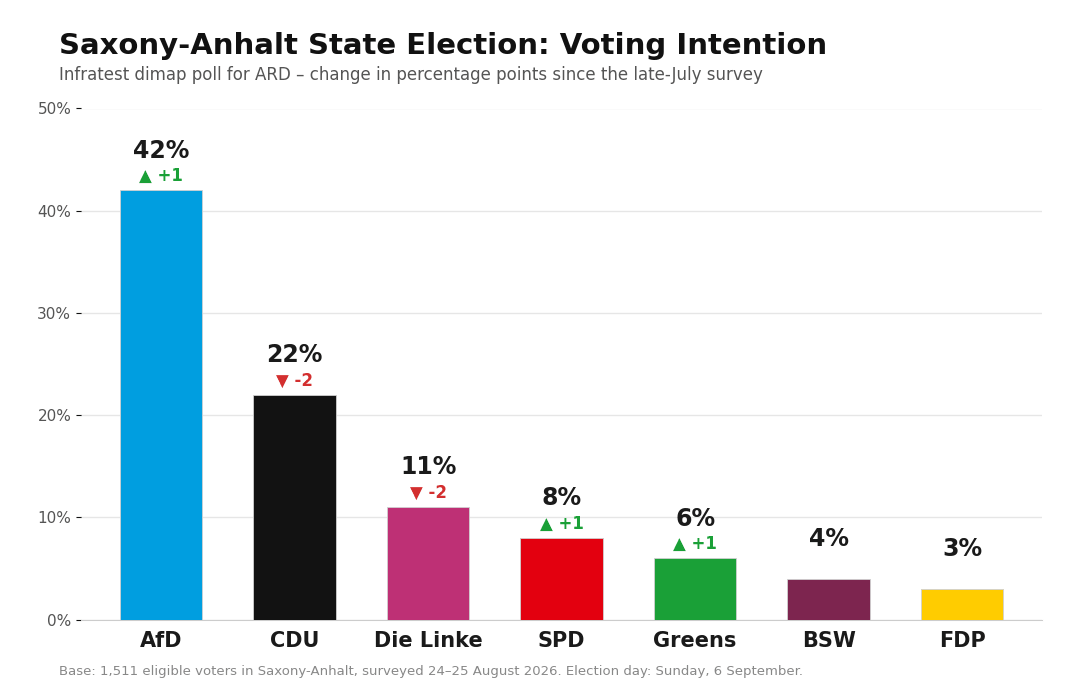
According to a poll by the Infratest dimap institute for ARD published on Wednesday, the AfD, classified as confirmed right-wing extremist by the state Office for the Protection of the Constitution, stands at 42 percent in Saxony-Anhalt. The CDU trails well behind on 22 percent.
Schulze conceded that the polling figures were "not what we would like them to be" and that the CDU in Saxony-Anhalt was facing "headwinds" from politics in Berlin. He defended his initiative, launched together with other eastern state premiers, to preserve the deduction-free pension for people with particularly long contribution records. On this point, he said, he takes a different view from Federal Chancellor Friedrich Merz (CDU).
"I will fight hard," Schulze said. "I will not vote in favour in the Bundesrat on issues that are important for Saxony-Anhalt." Merz, by contrast, intends to stick to the abolition of the "pension at 63".
Saxony-Anhalt goes to the polls on 6 September. Should it achieve the outright majority it is aiming for, the AfD has announced, among other things, a deportation offensive, the termination of the state broadcasting treaties and a baby welcome payment. Whether the AfD can ultimately govern alone also depends on how many parties enter the state parliament and how that affects the distribution of seats.
In the current ARD poll, the Left Party stands at eleven percent and the SPD at eight percent. The Greens reach six percent. The BSW on four percent and the FDP on three percent would fail to enter the state parliament.
After the head-to-head duel, the MDR panel was expanded to include the lead candidates of the Left Party, the SPD, the Greens, the FDP and the BSW. The Greens' lead candidate, Susan Sziborra-Seidlitz, said that "our six, seven percent is what matters" when it comes to preventing an AfD government.
SPD lead candidate Armin Willigmann stressed that his party wanted to "gain further ground". Lydia Hüskens of the FDP sees an "upward trend" for her party. BSW frontrunner Thomas Schulze, meanwhile, again made the case for a "change of political direction", which he said "will only come about with the BSW".
The other parties rule out coalitions with the AfD, although the BSW does not shut the door on other forms of cooperation with the party. Should the AfD fall short of the majority it needs to govern alone, a CDU-led minority government could emerge, which might then also depend on cooperation with the Left Party.
From breaking news to thought-provoking opinion pieces, our newsletter keeps you informed & engaged.
By subscribing, you agree to our Terms & Conditions and Privacy Policy.


